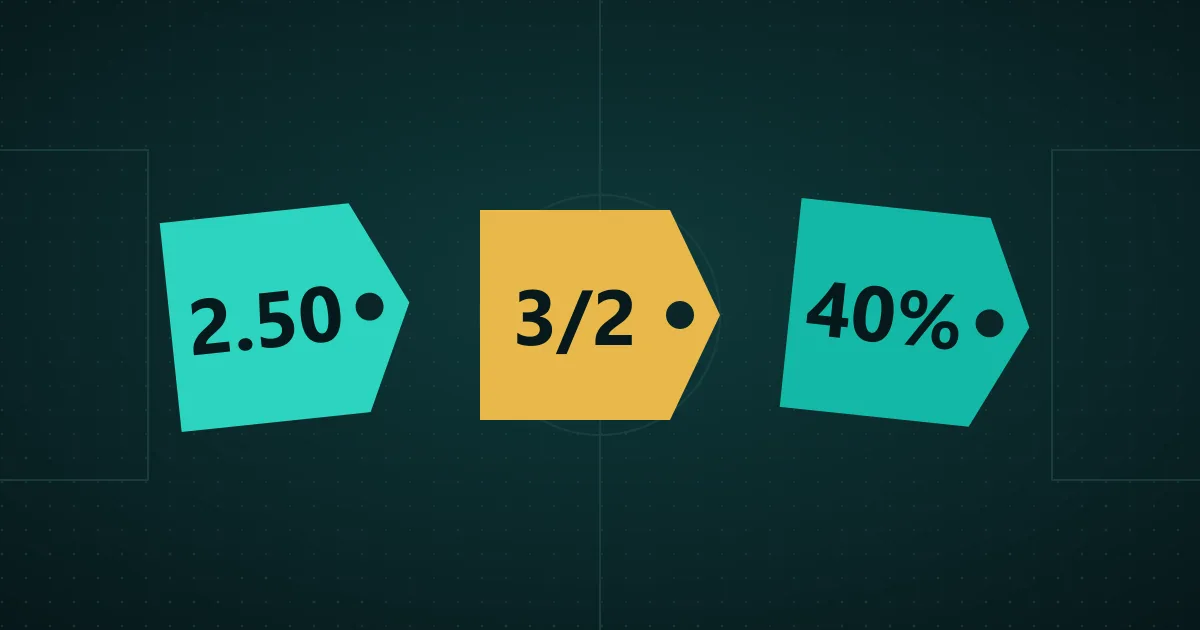
Odds are probabilities in disguise
Every betting price does two jobs. It tells you how much you win, and it tells you how likely the bookmaker thinks the outcome is. Most people read only the first. The second is where betting decisions are actually made, because a bet is only worth placing when you think the outcome is more likely than the price suggests.
This guide covers the three formats you will see, how to convert between them, and how to turn any price into a probability you can compare with your own judgement or with a model.
Decimal odds
Decimal odds are the standard across Europe, at betting exchanges and on most comparison sites, including FootyPulse. The number is your total return per unit staked, stake included.
- At 2.50, a £10 bet returns £25: £15 profit plus your £10 back.
- At 1.40, a £10 bet returns £14: £4 profit.
- At 6.00, a £10 bet returns £60: £50 profit.
The profit is always (odds − 1) × stake. Decimal odds are the easiest format to work with because the implied probability is simply 1 divided by the price.
Fractional odds
Fractional odds are traditional in the UK and Ireland, especially in horse racing and in high-street shops. The fraction is profit over stake.
- 3/2 means you win £3 for every £2 staked. A £10 bet returns £15 profit plus the £10 stake.
- 2/5 means you win £2 for every £5 staked. Short-priced favourites look like this.
- Evens (1/1) means you win the same as you stake.
To convert fractional to decimal, divide the top by the bottom and add 1: 3/2 = 1.5 + 1 = 2.50. 2/5 = 0.4 + 1 = 1.40.
American (moneyline) odds
You will meet these on US sites and in some apps. A plus sign shows the profit on a 100 stake; a minus sign shows how much you must stake to win 100.
- +150 means a 100 stake wins 150 profit, the same as decimal 2.50.
- −250 means you stake 250 to win 100, the same as decimal 1.40.
To convert: for a positive number, divide by 100 and add 1. For a negative number, divide 100 by the number (ignoring the sign) and add 1.
Turning odds into implied probability
Implied probability is the chance of an outcome that a price represents. With decimal odds it is one step:
Implied probability = 1 ÷ decimal odds
- 2.00 implies 50%.
- 2.50 implies 40%.
- 1.40 implies 71.4%.
- 6.00 implies 16.7%.
This is the most useful number in betting. If a team is priced at 2.50 (40%) and you have good reason to believe it wins 45% of the time, the bet has positive expected value. If you think it wins 35% of the time, it does not, however confident the team news makes you feel. Our guide to value betting builds on exactly this comparison.
Our free odds converter does every conversion in this guide instantly.
The margin hidden in every market
Add up the implied probabilities of every outcome in a market and you will get more than 100%. The excess is the bookmaker's margin, sometimes called the overround or vig.
Take a match priced Home 2.10, Draw 3.40, Away 3.60:
- Home: 1 ÷ 2.10 = 47.6%
- Draw: 1 ÷ 3.40 = 29.4%
- Away: 1 ÷ 3.60 = 27.8%
- Total: 104.8%
The 4.8% is the margin. It means the prices are, on average, about 4.8% worse than fair. To find the bookmaker's actual opinion, divide each implied probability by the total:
- Home: 47.6 / 104.8 = 45.4%
- Draw: 29.4 / 104.8 = 28.1%
- Away: 27.8 / 104.8 = 26.5%
These "margin-free" probabilities add up to 100%, and they are what you should compare with your own estimate. This simple proportional method is the most common; more precise methods exist, but for most purposes the difference is small. Our guide to bookmaker margin goes deeper into why margins differ between markets and bookmakers.
What the odds tell you about a match
Once you read odds as probabilities, a market becomes a forecast. The match above says the bookmaker rates the home side a 45% chance, which is close to the long-run home win rate in many leagues. Over the 12 months to October 2026, home teams won 40.0% of Premier League matches, 48.7% in La Liga and 45.5% in the Bundesliga, according to FootyPulse's match data. A price that implies a much higher or lower chance than a team's record suggests is the market telling you something: an injury, a tactical change or a mismatch in quality.
That is also why we put the bookmaker's margin-free chance next to the model's on every card on our mathematical predictions board. When the two agree, there is little to find. When they disagree by a few points, it is worth a closer look. When they disagree by a lot, the model is usually missing something.
Comparing prices between bookmakers
Different bookmakers price the same match differently, and the gap matters more than most bettors think. Taking 2.20 instead of 2.10 on a 45% chance turns a bet with negative expected value into a positive one:
- At 2.10: 0.45 × 2.10 = 0.945, so you expect to lose 5.5% of your stake.
- At 2.20: 0.45 × 2.20 = 0.99, almost break-even.
- At 2.30: 0.45 × 2.30 = 1.035, a 3.5% expected profit.
Over hundreds of bets, consistently taking the best price is one of the few reliable advantages a bettor has. It costs nothing but a few seconds of checking.
Common mistakes when reading odds
- Confusing short odds with safe bets. A 1.20 favourite still loses one time in six. Short odds mean high probability, not certainty.
- Ignoring the margin. Comparing your estimate with raw implied probabilities makes every bet look slightly worse than it is, and makes accumulators look far better than they are.
- Thinking in returns, not probabilities. "I could win £50" is the wrong question. "Is this outcome more likely than 1 in 6?" is the right one.
- Mixing formats. When comparing sites, convert everything to decimal first. Fractions such as 11/8 and 6/4 are hard to compare at a glance; 2.375 and 2.50 are not.
Responsible gambling
Understanding odds makes you a better-informed bettor, not a guaranteed winner. Bookmakers set prices for a living, and the margin means most bettors lose over time. Only bet what you can afford to lose, set limits before you start and never chase losses. Free, confidential help is available from BeGambleAware.