Why Asian handicap exists
A standard match bet has three outcomes: home, draw, away. That makes a short-priced favourite poor value and an underdog a long shot, and the draw sits in the middle catching a quarter of results.
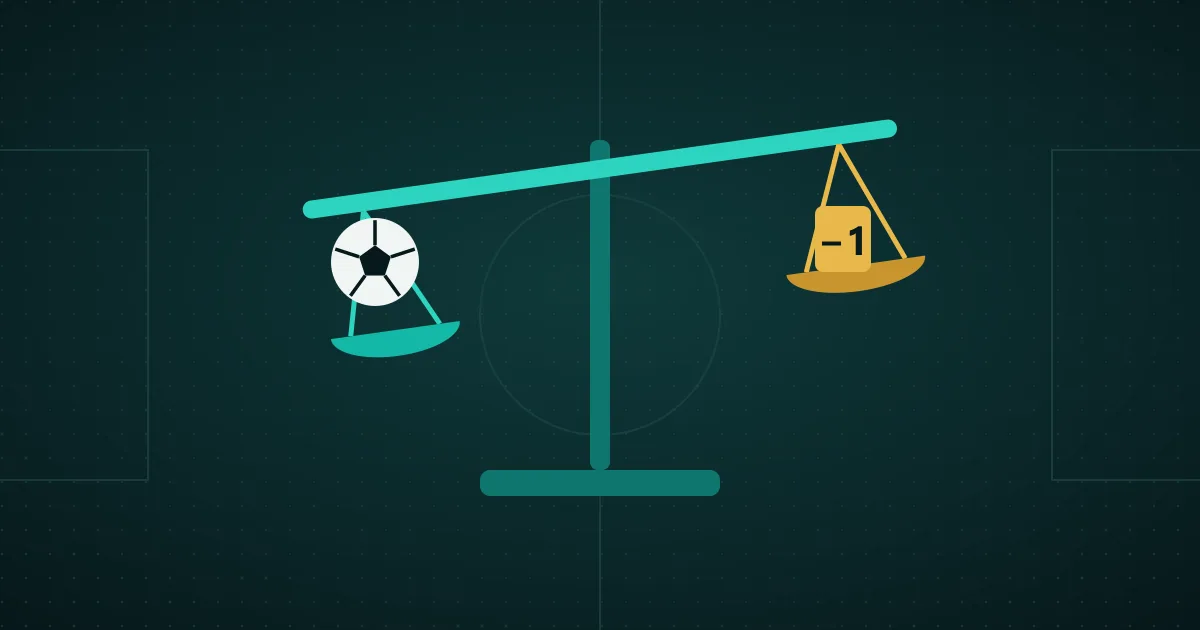
Asian handicap fixes this by giving one team a head start or a deficit measured in goals, so that the two sides are roughly even and there are only two outcomes to bet on. It began in Asian betting markets, which is where the name comes from, and is now one of the most heavily traded football markets in the world. Because it is a two-way market, margins are usually lower than on the three-way match result.
How the handicap works
The handicap is added to the team's final score. A team on −1 starts a goal behind; a team on +1 starts a goal ahead. You then compare the adjusted score.
There are three kinds of line: whole numbers (0, −1, +1), halves (−0.5, +1.5) and quarters (−0.25, −0.75). Each settles differently.
Half-goal lines: no draws possible
Half-goal lines are the simplest because a team cannot score half a goal, so there is always a winner.
- −0.5: your team must win. Any win settles the bet as a win; a draw or defeat is a loss. It is effectively a match-result bet without the draw.
- +0.5: your team must not lose. A win or a draw wins the bet. It is effectively the same as a double chance bet.
- −1.5: your team must win by two or more goals.
- +1.5: your team can lose by one goal and still win the bet.
Whole-goal lines: the stake can be returned
With a whole number, the adjusted score can be level. When that happens, the bet is a push and your stake is returned.
- 0 (draw no bet): your team wins, you win; your team loses, you lose; a draw, you get your stake back. It is the same bet bookmakers sell as "draw no bet"; our betting glossary lists it alongside the other bet types.
- −1: a win by two or more wins the bet, a win by exactly one returns your stake, and a draw or defeat loses.
- +1: a win or draw wins the bet, a defeat by exactly one returns your stake, and a defeat by two or more loses.
Quarter-goal lines: the stake is split
Quarter lines look confusing, but they are just two bets in one. Your stake is split equally between the two nearest lines.
−0.25 (half on 0, half on −0.5)
- Your team wins by any margin: both halves win, full win.
- Draw: the 0 half is returned, the −0.5 half loses. You lose half your stake.
- Your team loses: both halves lose.
−0.75 (half on −0.5, half on −1)
- Win by two or more: both halves win, full win.
- Win by exactly one: the −0.5 half wins, the −1 half is returned. You win half.
- Draw or defeat: both halves lose.
+0.25 and +0.75
These are the mirror images. +0.25 splits between 0 and +0.5, so a draw returns half your stake as a win and half as a refund (a half win). +0.75 splits between +0.5 and +1, so a one-goal defeat loses half and returns half.
A worked example with money
You stake £20 on a team at −0.75 at odds of 1.95, so £10 goes on −0.5 and £10 on −1.
- Team wins 2-0: both halves win. Return: £20 × 1.95 = £39 (£19 profit).
- Team wins 1-0: the −0.5 half wins (£10 × 1.95 = £19.50); the −1 half is a push (£10 back). Return: £29.50 (£9.50 profit).
- Draw 1-1: both halves lose. Return: £0.
The quarter line pays less than −1.5 when the team wins big, but protects you when it scrapes a one-goal win.
How often do favourites win by two or more?
Most of the value in Asian handicap betting comes from understanding winning margins. Here is how home and away wins split by margin across finished matches in the 12 months to 29 October 2026, from FootyPulse's match data:
- Premier League (370 matches): home win by exactly one 17.0%, by two or more 23.0%; away win by exactly one 19.2%, by two or more 11.6%.
- La Liga (380): home by one 24.5%, by two or more 24.2%; away by one 15.8%, by two or more 10.8%.
- Bundesliga (297): home by one 19.9%, by two or more 25.6%; away by one 16.5%, by two or more 12.8%.
- Serie A (386): home by one 22.5%, by two or more 18.4%; away by one 18.9%, by two or more 18.1%.
- Ligue 1 (296): home by one 21.6%, by two or more 22.3%; away by one 16.2%, by two or more 14.2%.
A few lessons follow. In La Liga, a home win was as likely to be by one goal as by two or more, so a home favourite at −1 had a real chance of a push. In the Bundesliga, home wins were more often comfortable than narrow. Away wins by two or more were much rarer everywhere except Serie A. If you back an away favourite at −1.5, you need strong reasons to expect a big win.
These are league averages: a title contender at home to a bottom-three side wins by two or more far more often. Our home and away statistics and team stats explorer give you the team-level picture.
Asian handicap versus the match result
For a strong favourite, the match-result price might be 1.30, an implied 77%. The same team at −1 might be around 1.90. You are trading a near-certain small return for a meaningful bet on a margin, and you get your stake back if they win by exactly one. Whether that is better depends on how you rate the winning margin, not on the team's chance of winning.
For an underdog, +0.5 or +1 turns a long-shot bet into a near coin flip. That is useful when you think the market is too confident in the favourite but not confident enough to back the underdog to win outright.
Common mistakes
- Misreading the sign. −1 means your team gives a goal start; +1 means it receives one. Check twice before you place a quarter-line bet.
- Forgetting the split on quarter lines. A "half win" on −0.75 is not a loss, and a "half loss" on −0.25 is not a push. Settlement is per half.
- Using the wrong match length. Asian handicap normally settles on 90 minutes plus stoppage time. Extra time and penalties do not count unless the market says so.
- Chasing big handicaps. −2.5 on a heavy favourite looks generous, but wins by three or more are rare even for the best teams.
Responsible gambling
Asian handicap is a precise tool, but precision does not remove the bookmaker's margin or the randomness of football. Set limits, keep stakes small and consistent, and stop if betting stops being fun. Help is available from BeGambleAware.